Your tests never ask an athlete to react.
Their sport always will.
Force plate, strength, and hop tests miss the reaction and decision-making that return-to-sport really demands. QuickBoard measures and trains that cognitive-motor layer, with protocols already built and sessions you can bill.
See QuickBoard in action.
Free Download
Get the RTS Reactive-Readiness Checklist
PT clinics and sports medicine facilities use this one-page tool during every return-to-sport evaluation. Email only. No demo required.
Not quite ready? Read the research first. → thequickboard.com/research
Everything Included
What a QuickBoard system includes
The sensor board
HD ($2,295) or HD Pro ($2,495). Lifetime warranty with active subscription. Made in the USA. Bluetooth pairs to your iPad.
The clinical protocol library
Pre-built protocols covering ACL, degenerative joint, lower extremity neurocognitive, upper extremity, pediatric lower extremity, concussion rehab, rehab warm-up, and balance. Custom protocol building available.
The Agility Rating
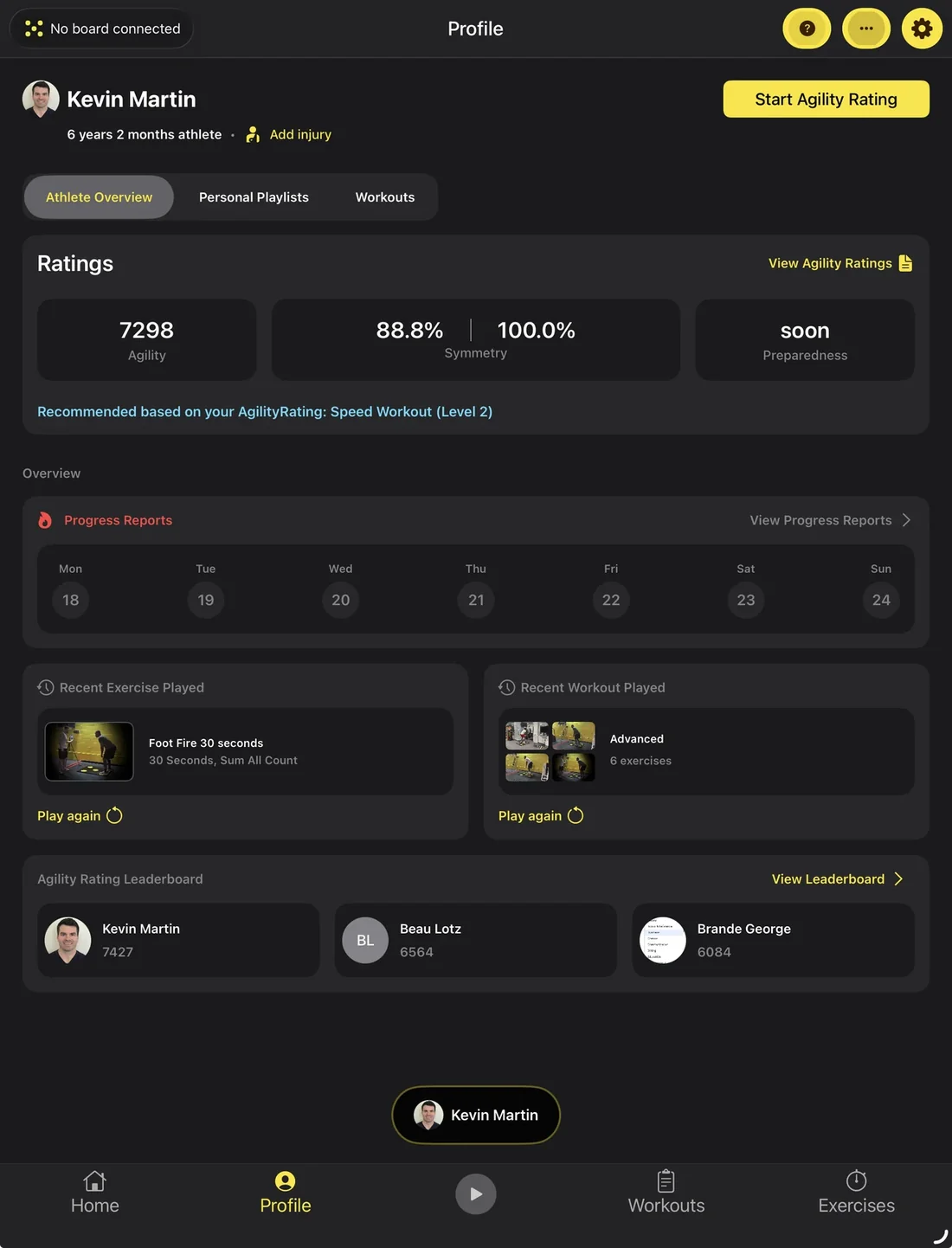
A composite 0-to-10,000 cognitive-motor assessment built from four scored exercises. Two-minute assessment. Auto-generates a PDF report with CPT 97750 billing documentation included.
Done-with-you onboarding
A QuickBoard rep walks your team through the clinical workflow, protocol library, and CPT billing setup. Live, on video. Most clinics are running their first patient session within 15 minutes of unboxing.
CPT billing documentation
The Agility Rating Report PDF includes the Description and Purpose text required for 97750 billing. Progress Reports support 97530 and 97112.
Automated PDF reports
Progress Report and Agility Rating Report generate automatically and export to your email after every session. No manual data entry.
QuickBoard Companion
Sync up to three iPads or iPhones for upper and lower extremity protocols simultaneously. Included at no extra cost.
Lifetime warranty
Lifetime warranty on hardware with an active subscription.
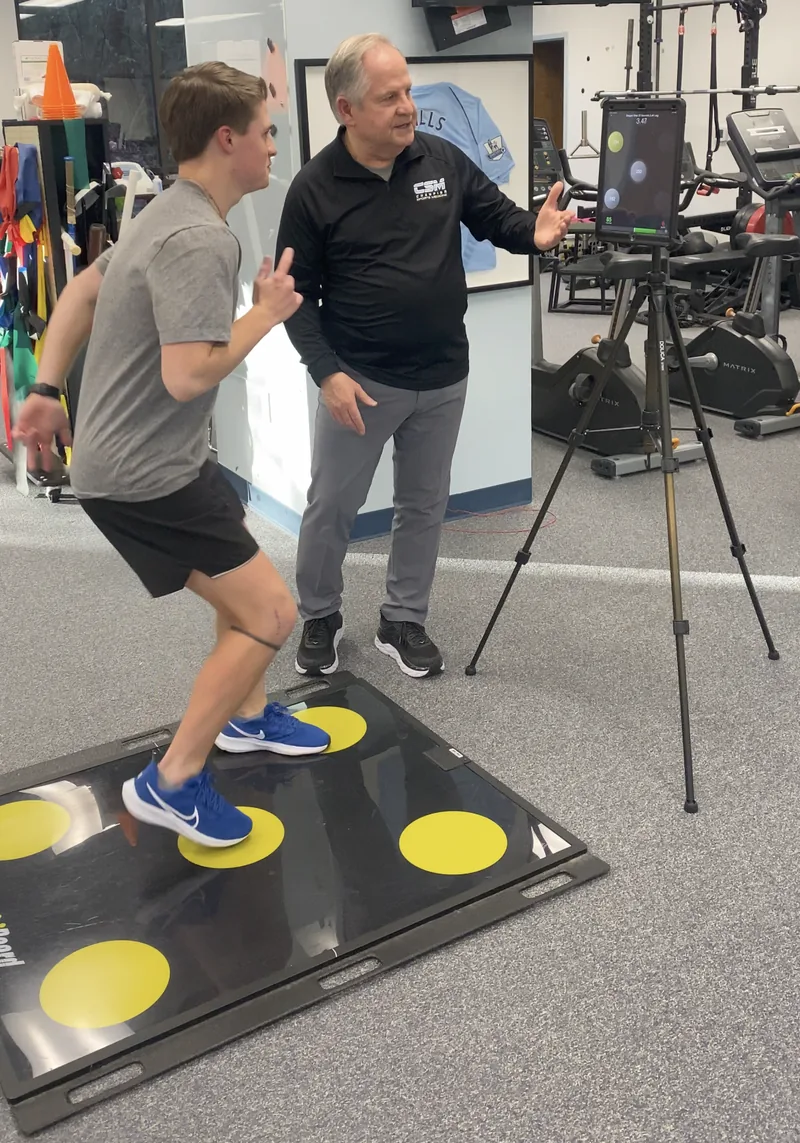
Built for real return-to-sport sessions.
The athlete runs a reactive stepping drill on the sensor board while the clinician tracks live reaction times on the iPad. Every rep is scored and saved, so the next session picks up where this one left off.
The price in context
Every QuickBoard system is one sensor board plus a software subscription. Choose the board that fits your population, then pick a software tier based on how many athlete or patient profiles you need. Billable under CPT 97750, 97530, 97112.
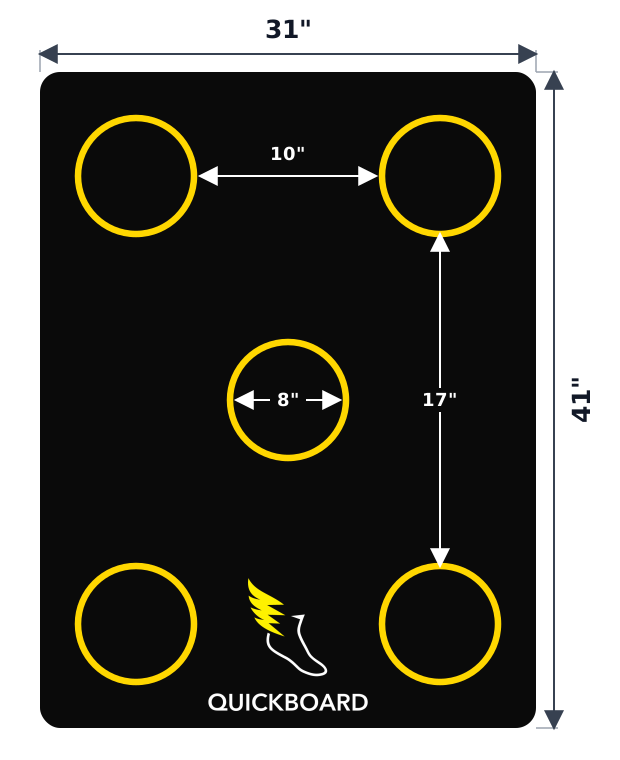
Designed for youth athletes and at-risk populations. Smaller footprint fits a private practice treatment room, school athletic training room, performance facility, or home gym.
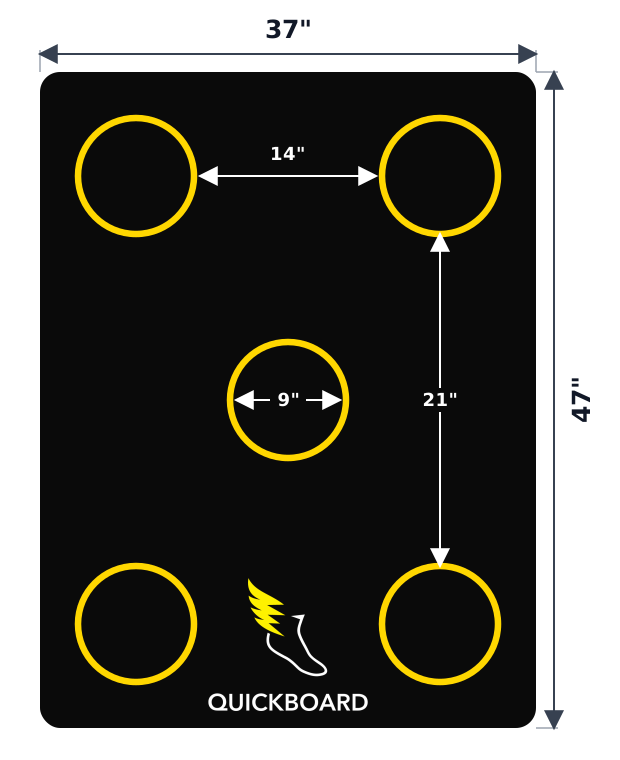
Designed for high school through adult athletes and general adult populations. Larger footprint accommodates a longer stride and bigger movement patterns.
Pick a tier by how many profiles you need, from Starter (25 profiles) to Enterprise (unlimited).
Not ready for the board?
The Agility Drill app is free. No hardware. Run reaction drills from an iPhone or iPad and see how cognitive-motor training works.
What clinicians say
"Quick Board has played a critical role in developing my pro tennis clients for the last 9 years. It allows me to identify my athletes' weaknesses and address them. Quick Board has exceeded my expectations by increasing my athletes' performance on the court and reducing their injuries."
 Abdul Sillah, High-Performance Coach, PEAK31
"The Quick Board is a game-changer for us. By tracking baseline data, we know if an athlete is trending in the right direction AND if they need more attention in certain areas. We use this for concussion, knee, ankle, hip, core, and shoulder rehab. One of the best pieces of technology to assist in quantifying return to play readiness."
 Dr. Andrea Davis, PT, MS, DPT
"I have been using the Quick Board for a couple of years now and have not only seen great results, but I have seen patient/athlete cooperation and compliance increase dramatically. Our clinic applies Quick Board for stability and return to function, including returning to weight-bearing symmetry. The Quick Board allows patients to perform and re-educate the nervous system while providing feedback with scores and errors. Overall, the Quick Board makes training athletes and rehabbing patients exciting, competitive, and fun."
 Dr. Chad Molen, DPT, SCS, CSCS, LMT
See clinical case studies from the Cleveland Cavaliers, University of Memphis, PEAK31, and Buckhead Elite Training Studio at thequickboard.com/case-studies.
Peer-Reviewed Evidence
The evidence behind it
QuickBoard is recommended technology for neurocognitive and neuromuscular rehabilitation. Every claim below names its source.
Neurocognitive and Neuromuscular Rehabilitation Techniques after ACL Injury
QuickBoard drills appear in this two-part clinical commentary as one way to add a brain challenge to ACL rehab.
Chmielewski et al. - ACL patients gained less on QuickBoard reaction tests than on hop tests
Independent research from TRIA Orthopedic Center. Hop and reaction results did not move together.
Galpin et al. - Board training improved foot speed 26% and reaction time 19%, and transferred to a separate change-of-direction test
After four weeks of foot speed and reaction training on the board, active adults new to agility training improved foot speed by 26% and reaction time by 19%. The training also transferred to a separate change-of-direction test that was not part of the program: about 0.45 seconds, roughly 7%, off an electronically timed course. The control group did not improve on any of the tests.
Martin - Reaction time moved with self-reported stress in Division I women's soccer players
A pilot study across a full competitive season. No control group.
Grindem et al. - delaying return to sport and meeting quad-strength symmetry together are tied to lower reinjury risk
“More symmetric quadriceps strength before return to sport is associated with lower reinjury risk.” QuickBoard's per-leg data is built to document that kind of decision rule, not replace it.
See the full research library at thequickboard.com/research →
Three clinical audiences. One system.
Pre-season baselines. In-season fatigue monitoring. Return-to-play testing.
Research-backed by Martin (2012), University of Louisville, and Galpin et al. (JSCR 2008). The Agility Rating gives you a composite score before the season starts and tells you what changed by the end.
Neurocognitive return-to-sport testing. Billable under three CPT codes.
Objective reaction and decision-making data for return-to-sport clearance. Automated billing documentation after every session.
Dual-task balance training for stroke, TBI, Parkinson's, and vestibular populations.
Bilateral symmetry tracked under cognitive load. The Balance Protocol is built for at-risk and neuro populations.
What makes it different from every other reactive tool
Program once. QuickBoard delivers it.
Program a protocol once. QuickBoard runs it with real-time feedback while you treat another patient. No other system automates protocol delivery this way.
External focus beats watching your feet.
The visual cue and real-time feedback appear on the iPad screen. The sensors capture touches on the floor. Across many studies, attention on an outside target has produced better performance than attention on the body itself (Wulf, 2001).
Contact time. Reaction time. Accuracy.
Right vs. left deficit reported automatically. Automated PDF reports after every session. No manual data entry.
Go/No-Go. Stroop. Dual-task. Discrimination.
Cognitive demand layered on top of motor output. The training model others can't replicate.
97750. 97530. 97112.
The Agility Rating assessment bills under 97750. Therapeutic activities under 97530. Neuromuscular re-education under 97112.
Sync up to three iPads or iPhones.
Upper and lower extremity simultaneously. An ACL patient catches a ball while cutting. A fall-risk patient reaches while stepping.
The hands don't rest while the feet react.
QuickBoard Companion syncs up to three additional iPads or iPhones to the sensor board session, each running one or more reaction stimuli.
Reaction exercises
Feet react on the board while hands react on the synced devices, at the same time.
Speed-focused exercises
Feet drive the board while hands react to stimuli on the companions.
Fully automated
The protocol runs on its own, so the clinician or coach is free to work with other patients or athletes while it runs.
One unified report
Companion reaction times save alongside the sensor board results, no separate system to reconcile.
That is what makes evidence-based dual-task training practical here. Done by hand, it is labor-intensive and the scoring is subjective.
Three ideas from motor-learning research support Companion.
Attention on an outside target beats attention on the body, across skill levels and ages (Wulf, 2013).
QuickBoard training has shown this same transfer. Board training has carried over to unpracticed agility tests (Galpin, 2008) and balance tests (Paquette, 2016). A separate study found dual-task practice improved a completely different, untrained movement (Schaefer & Lang, 2012).
Return-to-sport researchers are reaching the same conclusion. Standard testing is single-task, but real injuries and real sport are not. Testing should add a cognitive load too (Grooms et al., 2023; Chaaban et al., 2023). That is the case for Companion: dual-task training and testing, not single-task drills in isolation.
From unbox to first patient in under 15 minutes
Choose a protocol
QuickBoard ships with the pre-built clinical protocol library. Pick a protocol, or run the Agility Rating to get a targeted protocol recommendation.
Patient steps on
The patient steps onto the sensor board. QuickBoard's software runs the protocol automatically with real-time feedback.
Objective data, captured
Reaction time, ground contact time, bilateral symmetry, and accuracy are recorded to the millisecond.
Automated PDF reports
Progress Report and Agility Rating Report generate as PDFs and export to your email. The Agility Rating Report includes the CPT 97750 Description and Purpose pre-filled.
Common questions.
QuickBoard is a cognitive-motor rehabilitation and performance training system. It pairs a sensor board with an iPad app that automates reaction training, decision-making tests, and return-to-sport assessments. QuickBoard is recommended technology for neurocognitive and neuromuscular rehabilitation, named in leading peer-reviewed clinical guidance published in the International Journal of Sports Physical Therapy.
QuickBoard serves four audiences: Sports Performance and Strength & Conditioning coaches, Ortho Rehab clinicians (PTs and ATCs), Fall Prevention and Neuro rehabilitation specialists, and anyone running agility drills (coaches, clinicians, athletes, and parents) via the free Agility Drill app.
QuickBoard is billable under three CPT codes: 97750 (Physical Performance Test) for the Agility Rating, 97530 (Therapeutic Activities) for functional protocol sessions, and 97112 (Neuromuscular Re-education) for neuro rehab protocols. The software pre-populates billing documentation for each session.
QuickBoard displays visual stimuli and real-time movement feedback on the iPad screen while sensors sit on the floor. The iPad feedback keeps patient attention on the screen during drills rather than on the feet, which trains external focus and produces proprioceptive benefits. Portable reaction lights position light pods on the ground as the visual target. QuickBoard also tracks bilateral symmetry under full body weight, auto-generates Progress Reports as PDFs, and is recommended technology for neurocognitive and neuromuscular rehabilitation.
The Agility Rating is a composite score from 0 to 10,000 built from four scored exercises. It measures explosiveness, reaction, proprioception, movement efficiency, and bilateral symmetry. The assessment takes under 2 minutes and is billable under CPT 97750.
The HD Sensor Board is $2,295. The HD Pro is $2,495. Both include a lifetime warranty with active subscription. Software subscriptions range from $49.99/month (25 profiles) to $199.99/month (unlimited profiles). Payment plans up to 6 months are available for qualifying clinics. The Agility Drill app is free to individual users, parents, and athletes.
Yes. QuickBoard is recommended technology for neurocognitive and neuromuscular rehabilitation. In independent research from TRIA Orthopedic Center, ACL patients gained less on QuickBoard reaction tests than on hop tests after return-to-sport training (Chmielewski et al., IJSPT 2024). Galpin et al. (JSCR 2008) found active adults who trained foot speed and reaction on the board for four weeks improved foot speed by 26% and reaction time by 19%, and the training also transferred to a separate change-of-direction test not part of the program: about 0.45 seconds, roughly 7%, off an electronically timed course. The control group did not improve. Martin (2012), a University of Louisville master's thesis pilot, found reaction time moved with self-reported stress in Division I women's soccer players across a season.
See protocol automation, the Agility Rating, and CPT billing in 15 minutes.
Pick a time. We walk your team through the clinical workflow, show real patient reports, and answer questions about CPT billing.