
Your tests never ask an athlete to react.
Their sport always will.
QuickBoard is a sensor board and iPad app that tests and trains how fast people react and move while thinking.
Board from $2,295. Software from $49.99 a month.
5.4% faster Agility T-Test after four weeks of QuickBoard training, versus 2.3% with agility ladder training. Randomized study, 64 men's college basketball players (Zhang et al., Frontiers in Physiology, 2026). Read the study
Used by clinicians and performance staff at
- Johns Hopkins
- Baylor Scott & White
- Select Medical
- Banner Health
- NBA, NFL and MLB teams
Find your setting.

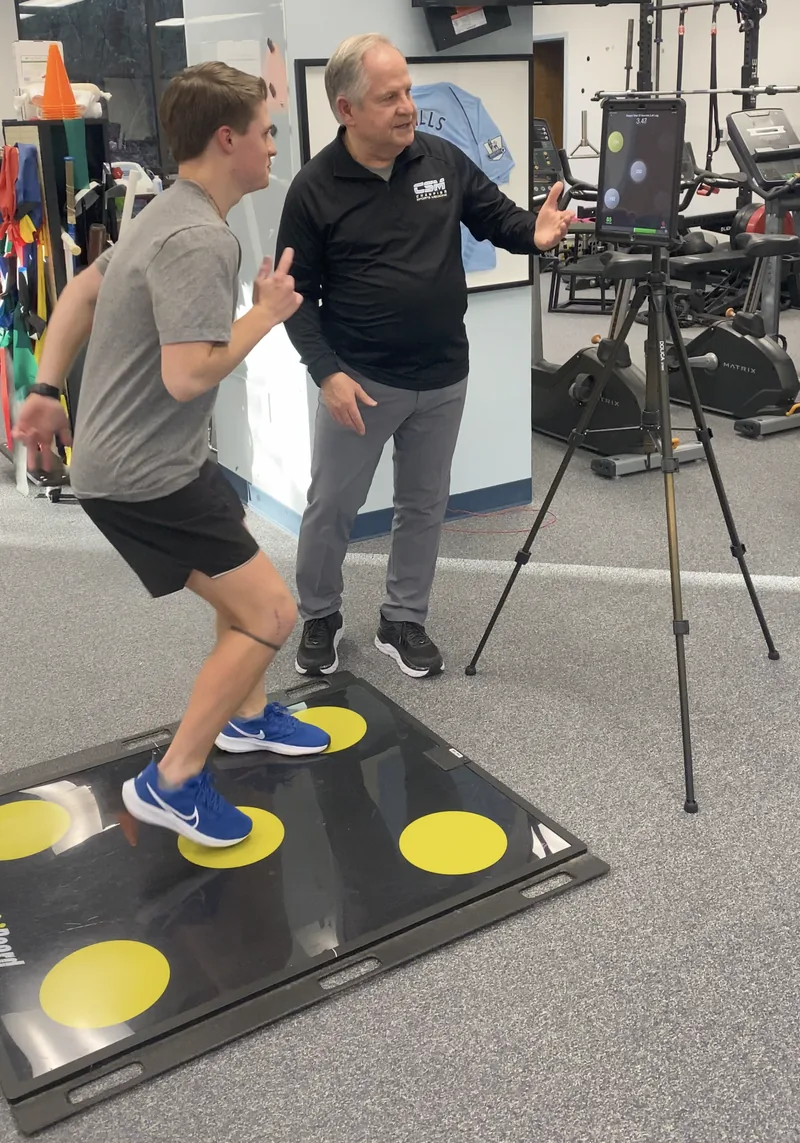

Step on. React. See the score.
Most teams run their first session within 15 minutes of unboxing.
Step on the board
Seven sensors read every foot contact. The board pairs to your iPad over Bluetooth.
React to the cue
The iPad shows a random target. They have to see it, decide and move. Eyes stay up on the screen, not down on the feet.
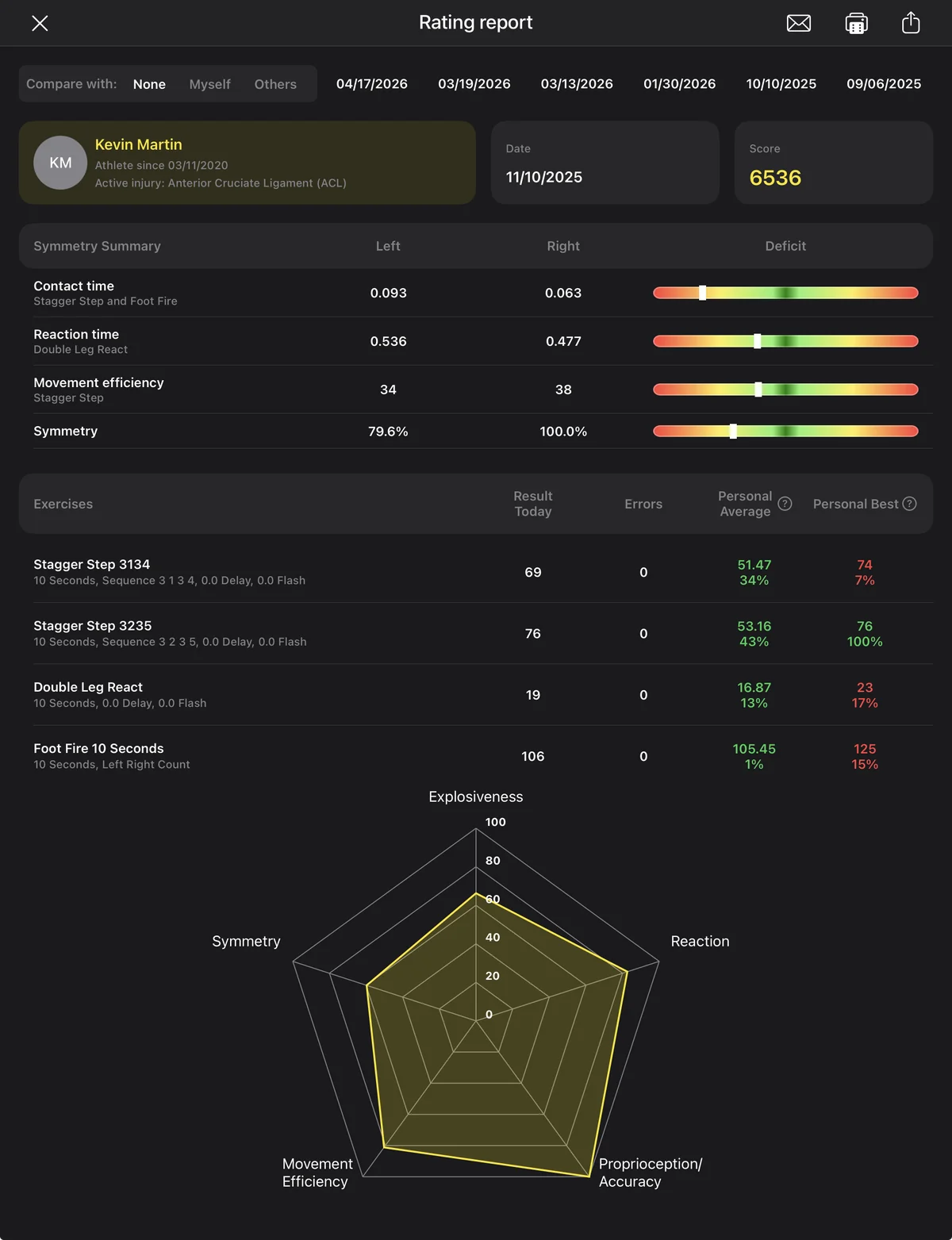
See the score
Reaction time, ground contact time, left and right symmetry, and accuracy. Saved on every rep. Sent as a PDF.
The evidence behind it.
faster Agility T-Test after four weeks of QuickBoard training, versus 2.3% with agility ladder training.
Randomized study, 64 men's college basketball players. Zhang et al., Frontiers in Physiology, 2026. Read the study
faster, about 0.45 seconds, on a separate change-of-direction test that was not part of the four-week board training.
Active adults new to agility training. On the board, foot speed improved 26% and reaction time 19%. The control group did not improve on any test. Galpin et al., JSCR, 2008.
QuickBoard drills appear in a two-part clinical commentary as one way to add a brain challenge to ACL rehab.
Neurocognitive and Neuromuscular Rehabilitation Techniques after ACL Injury. Clinical commentary, IJSPT, 2024.
Not ready to talk? Get the RTS Reactive-Readiness Checklist.
A two-page tool for return-to-sport evaluations. Email only. No demo required.
"Quick Board has played a critical role in developing my pro tennis clients for the last 9 years. It allows me to identify my athletes' weaknesses and address them. Quick Board has exceeded my expectations by increasing my athletes' performance on the court and reducing their injuries."

"I have been using the Quick Board for a couple of years now and have not only seen great results, but I have seen patient/athlete cooperation and compliance increase dramatically. Our clinic applies Quick Board for stability and return to function, including returning to weight-bearing symmetry. The Quick Board allows patients to perform and re-educate the nervous system while providing feedback with scores and errors. Overall, the Quick Board makes training athletes and rehabbing patients exciting, competitive, and fun."

See case studies from the Cleveland Cavaliers, University of Memphis, PEAK31 and Buckhead Elite Training Studio on the case studies page.
One board. One software plan. Every price is public.
Lifetime warranty with an active subscription. Return the board within 30 days of the sale for a refund of the purchase price. Clinics can bill under CPT 97750, 97530 and 97112.
Common questions.
QuickBoard is a cognitive-motor rehabilitation and performance training system. It pairs a sensor board with an iPad app that automates reaction training, decision-making tests, and return-to-sport assessments. QuickBoard is recommended technology for neurocognitive and neuromuscular rehabilitation, named in leading peer-reviewed clinical guidance published in the International Journal of Sports Physical Therapy.
QuickBoard serves four audiences: Sports Performance and Strength & Conditioning coaches, Ortho Rehab clinicians (PTs and ATCs), Fall Prevention and Neuro rehabilitation specialists, and anyone running agility drills (coaches, clinicians, athletes, and parents) via the free Agility Drill app.
QuickBoard is billable under three CPT codes: 97750 (Physical Performance Test) for the Agility Rating, 97530 (Therapeutic Activities) for functional protocol sessions, and 97112 (Neuromuscular Re-education) for neuro rehab protocols. The software pre-populates billing documentation for each session.
QuickBoard displays visual stimuli and real-time movement feedback on the iPad screen while sensors sit on the floor. The iPad feedback keeps patient attention on the screen during drills rather than on the feet, which trains external focus and produces proprioceptive benefits. Portable reaction lights position light pods on the ground as the visual target. QuickBoard also tracks bilateral symmetry under full body weight, auto-generates Progress Reports as PDFs, and is recommended technology for neurocognitive and neuromuscular rehabilitation.
The Agility Rating is a composite score from 0 to 10,000 built from four scored exercises. It measures explosiveness, reaction, proprioception, movement efficiency, and bilateral symmetry. The assessment takes under 2 minutes and is billable under CPT 97750.
The HD Sensor Board is $2,295. The HD Pro is $2,495. Both include a lifetime warranty with active subscription. Software subscriptions range from $49.99/month (25 profiles) to $199.99/month (unlimited profiles). Payment plans up to 6 months are available for qualifying clinics. The Agility Drill app is free to individual users, parents, and athletes.
Yes. QuickBoard is recommended technology for neurocognitive and neuromuscular rehabilitation. In independent research from TRIA Orthopedic Center, ACL patients gained less on QuickBoard reaction tests than on hop tests after return-to-sport training (Chmielewski et al., IJSPT 2024). Galpin et al. (JSCR 2008) found active adults who trained foot speed and reaction on the board for four weeks improved foot speed by 26% and reaction time by 19%, and the training also transferred to a separate change-of-direction test not part of the program: about 0.45 seconds, roughly 7%, off an electronically timed course. The control group did not improve. Martin (2012), a University of Louisville master's thesis pilot, found reaction time moved with self-reported stress in Division I women's soccer players across a season.
See it run on a 15-minute call.
One protocol, one Agility Rating and the PDF reports, live. Bring your billing and workflow questions.
Not ready for the board?
The Agility Drill app is free. No hardware. Run reaction drills from an iPhone or iPad.