
Force plates measure the force. QuickBoard measures the reaction.
QuickBoard is a cognitive-motor training system. It measures reaction and decision speed, not force output. Many PT clinics, sports medicine programs, and athletic training rooms use both as part of a complete return-to-sport protocol.
They answer different clinical questions.
Neither replaces the other. Each one tests something the other cannot.
Is this athlete strong and symmetric?
- Ground reaction force
- Limb symmetry index
- Power output and jump height
- Eccentric and concentric force
Force, measured directly, under pre-planned single-task conditions.
Can this athlete react and decide under cognitive load?
- Reaction time to visual stimuli
- Decision speed under cognitive load
- Bilateral symmetry during reactive movement
- Accuracy under dual-task conditions
The conditions injuries actually happen in. QuickBoard also reports jump height, air time, and reactive strength index, plus estimated impulse, average force, and peak power calculated from body weight and flight time rather than measured.
Neither replaces the other. They measure different categories of readiness.
Passing the physical battery does not close the reinjury gap.
This is not a critique of strength and hop testing. It is what the published return-to-sport research reports about athletes who cleared those tests.
Roughly 1 in 4
Young athletes who return to sport after ACL reconstruction reinjure at roughly one in four.
Passing did not lower the risk
Athletes who passed all six return-to-sport criteria reinjured at rates no lower than athletes who failed them.
90% of a weaker leg
A 90% symmetry score can be 90% of an already weakened leg. In this study of ACL patients, 57% cleared the 90% bar. Only 29% were back to their pre-injury capacity.
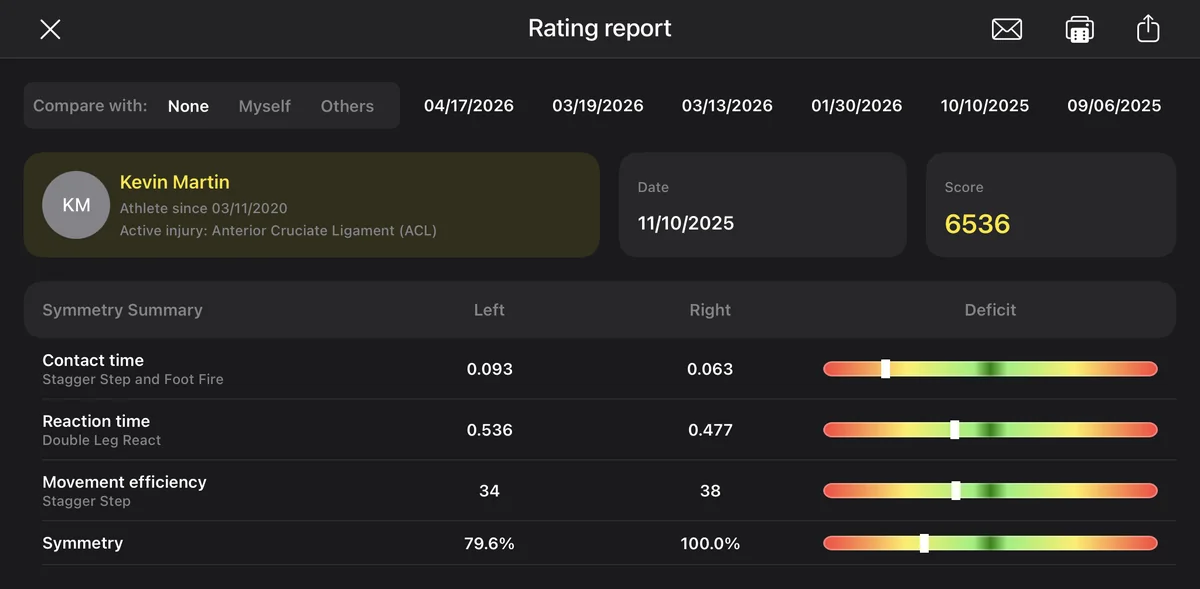
A clean symmetry score can still hide a reactive deficit.
Hop symmetry and reactive readiness are not the same thing.
Advanced Neuromuscular Training Differentially Changes Performance on Visuomotor Reaction Tests and Single-leg Hop Tests in Patients with ACL Reconstruction
Independent research from TRIA Orthopedic Center used QuickBoard as the reaction test. After a five-week return-to-sport program, ACL patients improved more on hop tests than on reaction tests. Hop and reaction results did not move together. The authors conclude patients may still lean on extra mental effort to move, and they call for more dual-task challenges in rehab.
This is why many clinics add QuickBoard to their existing RTS protocol rather than swap tools out.
See the full research library →Reaction time was the signal. Jump testing was not.
Division I Soccer Pilot: Reaction Time Moved With Self-Reported Stress.
In a University of Louisville master's thesis pilot, researchers tested 17 Division I women's soccer players weekly across a full competitive season, with no control group. Slower reaction times went along with more self-reported stress symptoms.
Vertical jump and peak power, measured on a flight-time contact mat, did not change significantly over the season. The author calls it a pilot that shows early promise for reaction time as a fatigue check.
See the full research library →Three billable CPT codes for revenue expansion.
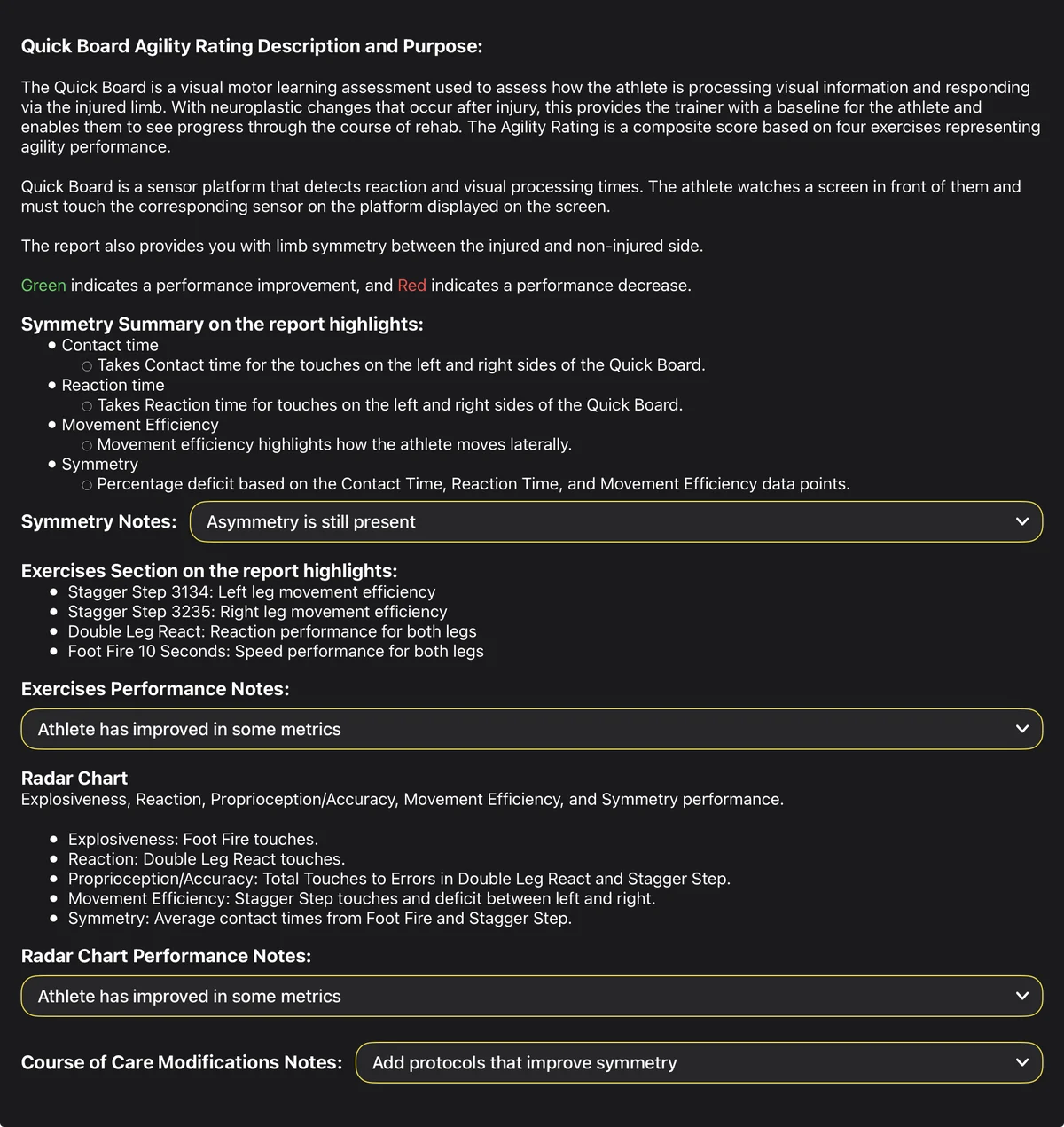
A clinic already running performance testing has the clinical basis to bill QuickBoard sessions. The Agility Rating auto-generates the CPT 97750 documentation as a PDF after every assessment.
Physical Performance Test
The Agility Rating assessment. The auto-generated PDF includes the Description and Purpose text required for billing. Billed in 15-minute increments.
Therapeutic Activities
Functional protocol sessions on the sensor board. Go/No-Go, Discrimination, Stroop, and reactive stepping protocols qualify.
Neuromuscular Re-education
Neuro rehab and dual-task protocols. Pre-populated billing descriptions generated automatically after every session.
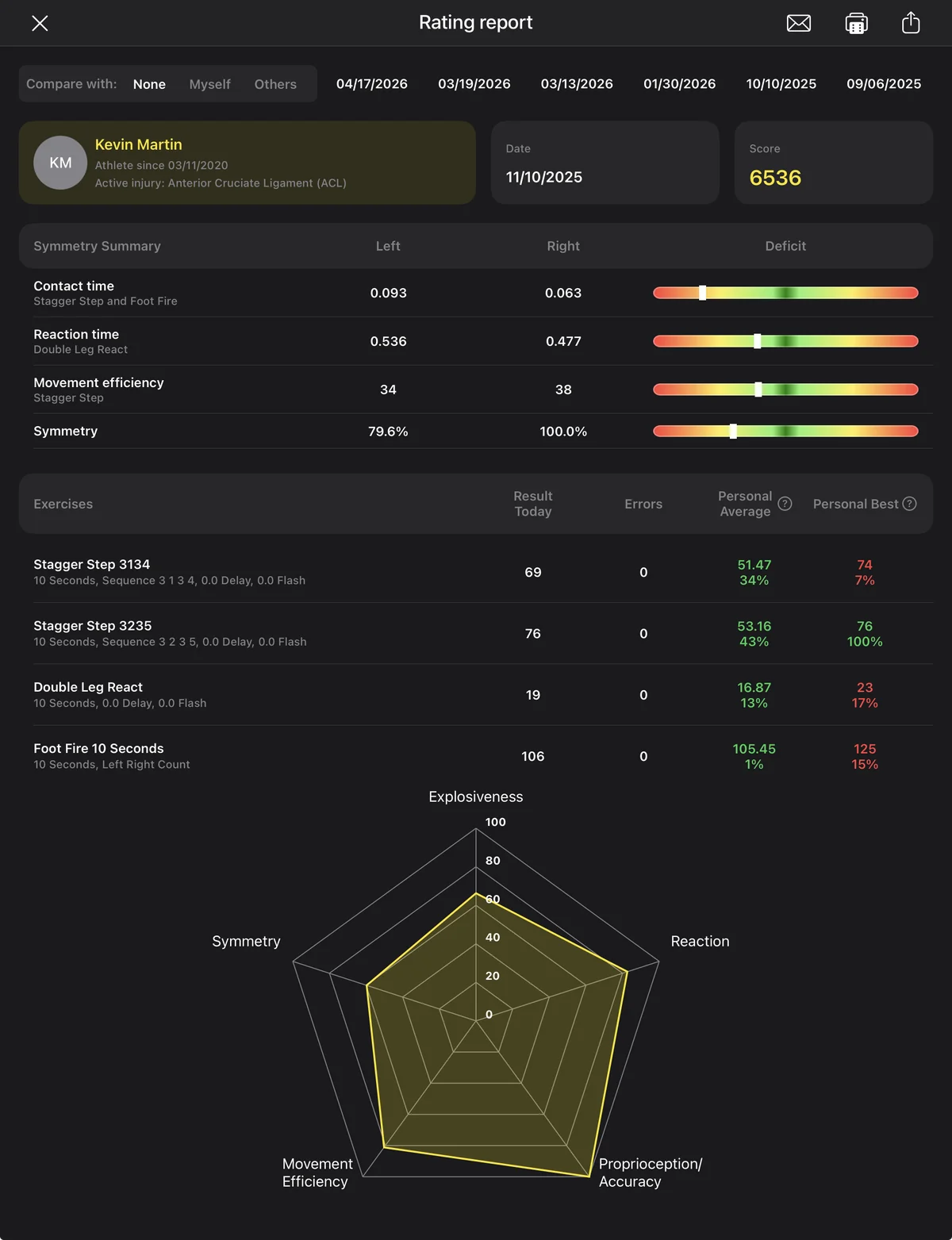
From a clinician who quantifies RTS readiness.
The Quick Board is a game-changer for us. By tracking baseline data, we know if an athlete is trending in the right direction AND if they need more attention in certain areas. We use this for concussion, knee, ankle, hip, core, and shoulder rehab. One of the best pieces of technology to assist in quantifying return to play readiness.

The cognitive-motor layer your existing protocol is missing.
QuickBoard is recommended technology for neurocognitive and neuromuscular rehabilitation. It ships with pre-built protocols mapped to the four stages of ACL rehabilitation: acute, sub-acute, functional, and return-to-sport.
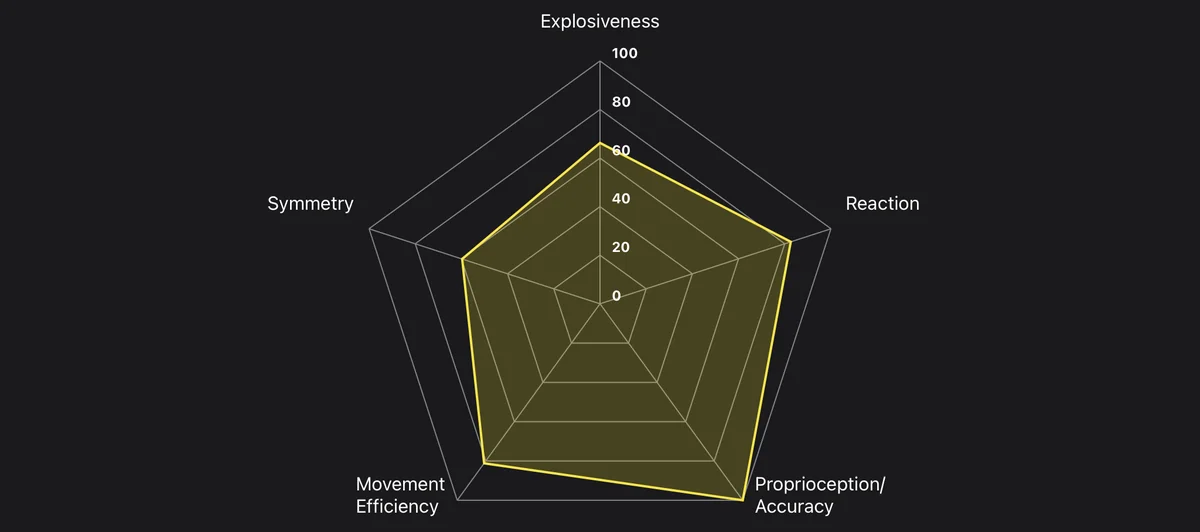
A strength and hop-test battery measures what the body produces. QuickBoard adds the neurocognitive layer: reactive decision-making under cognitive load. It delivers that layer with automated protocol running, bilateral symmetry tracking, and PDF reports after every session.
This is not about replacing any instrument in the battery. It is about closing the gap they leave in the RTS decision.
Strength, symmetry, and hop tests
Physical readiness. Force output under pre-planned conditions. Bilateral strength ratios. Hop distance.
Reactive readiness under cognitive load
Reaction time to visual stimuli. Decision speed. Bilateral symmetry during reactive stepping. Dual-task performance. Automated scoring and PDF reports.
See QuickBoard in action.
Common comparison questions.
No. Force plates and QuickBoard answer different clinical questions. Force plates measure ground reaction force, limb symmetry index, and power output. QuickBoard measures reaction time, decision speed, and bilateral symmetry under cognitive load. These are different categories of measurement. Many clinics run both in the same RTS protocol.
QuickBoard adds the cognitive-motor layer that standard physical testing does not cover. Chmielewski et al. (IJSPT 2024), independent research from TRIA Orthopedic Center, used QuickBoard as the reaction test. After return-to-sport training, ACL patients gained less on the reaction tests than on hop tests. QuickBoard tests and trains that reactive layer. For PT clinics, it also supports three CPT codes (97750, 97530, 97112) and auto-generates billing documentation as a PDF after every session.
Keep reading
See the Clinical Workflow in 15 Minutes
We walk your team through the RTS protocol, show real patient reports, and answer questions about how QuickBoard fits alongside your existing testing setup.
Explore the published research →